 Spain
Spain
Spain vs Argentina 1:0: How the World Cup Final Was Decided by a Player Who Wasn't in the Starting XI
Final score: Spain 1:0 Argentina — the match was played on 19 July 2026, East Rutherford.
01 Match Stats
What is xG? →// MATCH STATISTICS: Spain — Argentina
02 Key Facts
What is Crime Index? →Key Facts
Spain vs Argentina — 1:0 (FIFA World Cup). The win is backed by expected goals: xG 1.94 — 0.22. Match Crime Index — 35%: the scoreline matches the quality of play.
03 Lineups
Starting Lineups
- 23Unai SimónG
- 12Pedro PorroD
- 22Pau CubarsíD
- 14Aymeric LaporteD
- 24Marc CucurellaD
- 16RodriM
- 8Fabián RuizM
- 19Lamine YamalM
- 10Dani OlmoM
- 15Alex BaenaM
- 21Mikel OyarzabalF
- 23Emiliano MartínezG
- 4Gonzalo MontielD
- 13Cristian RomeroD
- 6Lisandro MartínezD
- 3Nicolás TagliaficoD
- 7Rodrigo De PaulM
- 24Enzo FernándezM
- 20Alexis Mac AllisterM
- 15Nicolás GonzálezM
- 10Lionel MessiF
- 9Julián AlvarezF
04 Breakdown
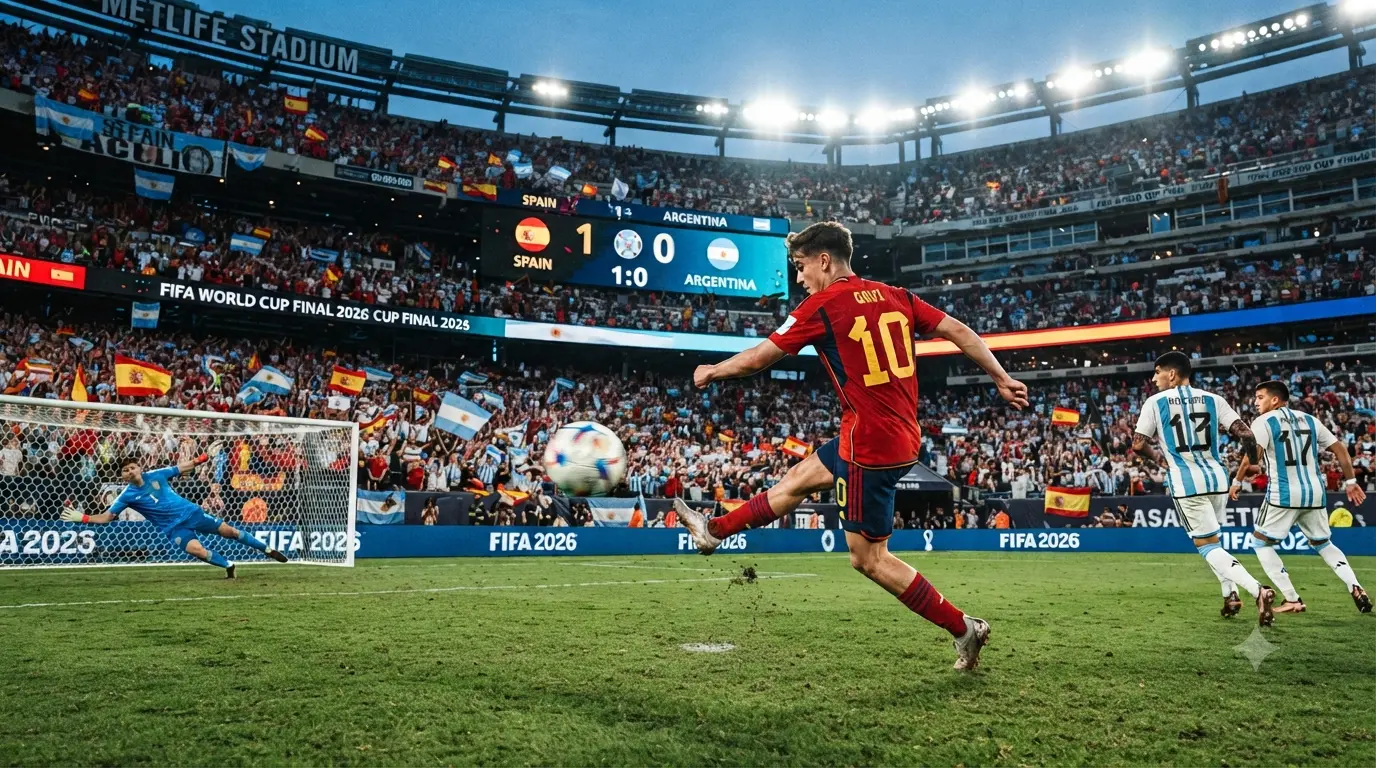
World Cup finals do not get replayed. Argentina had one chance to break Spain's defense over 120 minutes, and it failed so systematically that by the 106th minute, Torres's goal looked less like a shock than a formality the match had been delaying.
The Bench Won This Final
Torres was not in Spain's starting eleven. Luis de la Fuente opened the biggest match in four years with Oyarzabal up front — and it was a substitution, not the starting plan, that scored the winner. That is not an accident dressed up as a storyline: Spain had been building toward this moment all match, rotating fresh legs into a defense that Argentina simply ran out of legs to match. Torres came on once the space had already been worn down, and did exactly what he was sent on to do.
For the man who scores the winner in a World Cup final, that minute is the kind that splits a career into before and after. In Bravsen's numbers it is the sixth goal from a substitution introduced at minute 44 or later across both squads — the only difference is this one closed the tournament.
120 Minutes Argentina Never Left Their Own Third
Possession split 65-35 proves nothing by itself unless it comes with what stood behind it: 852 passes to 463, 762 of them accurate for Spain against 357 for Argentina. This was not cautious circulation — it was 20 shots, 12 of them on target, and nine corners that methodically pinned Argentina back into their own box all night.
Argentina, for comparison, managed two shots all match and put none of them on target. At 0.22 xG, that is not a story about brave defending clearing the ball off the line again and again — it is a story about a team that rarely got near the opposition goal at all. Messi and Julián Álvarez played what may be a career final and a season-defining night, respectively, in conditions where the ball simply did not reach their part of the pitch often: Spain's 4-2-3-1, working through Rodri, Fabián Ruiz and Lamine Yamal, took the space between the lines before Argentina's attack could ever occupy it.
A Wall Named Martínez
If this final had a hero for ninety minutes before Torres's goal, it was Emiliano Martínez. Eleven saves off twelve shots on target is the stat that explains why the score stayed level for so long despite a 1.72 xG gap. Every save he made pushed the resolution back a few more minutes and denied Spain the right to treat the win as a formality in advance. That is exactly why the match's anomaly score sits at just 35% — an honest reading: the result matched the quality of play, it just arrived later on the scoreboard than it should have, purely because of one man in goal.
90+3: The Cost Of Resistance
By the end of normal time, Argentina had collected all seven cards in the match — six yellows and Enzo Fernández's red at 90+3. None of them were random indiscipline. They were the price of repeated last-ditch challenges, a team forced again and again to stop an attack with a foul because it no longer had the legs to do it legally. The red card did not create Spain's edge — it simply removed the last defensive option from a side that had no room left to maneuver anyway.
Twelve substitutions, evenly split between the two coaches, tell their own story: both De la Fuente and Scaloni were still trying to change the shape of the game right up to the final whistle. Spain's substitutes entered a structure that kept functioning. Argentina's entered a storm that never really passed.
The 106th Minute
Torres's goal at 106 minutes was not an isolated moment — it was the conclusion of a script that had been readable since the first half. Set against Martínez's eleven saves and Spain's own clean sheet, Argentina held out longer in extra time than the underlying numbers suggested they could, but not long enough to reach penalties. A finishing-luck multiplier of ×0.52 for Spain against ×0.00 for Argentina says the same thing in the model's own language: this was not a stolen win. It was a win that arrived exactly as late as it took to finally beat the goalkeeper.
Case Closed
A World Cup final is the one match either country plays once every four years, with no fixture next week to put it right. Spain played it as though a full class gap needed no argument beyond the scoreboard: 1.94 xG to 0.22, 20 shots to two, 65% possession, and finally, a goal from a player sent on for precisely this moment. For Argentina, and for anyone who watched what may stand as Messi's last major tournament at this level, the consolation is that the resistance held until the 106th minute — and that the goalkeeper did almost everything that was humanly possible to stretch it further.


